
Risk & assurance
Internal Audit Management
Smart audits.
Every finding, followed through to closure.
Plan and run audits on mobile, capture evidence, score each unit and track findings through response and closure across branches, stores, plants or depots.
Plan your product walkthroughFrom branch fieldwork
to a reviewable audit trail.
Follow the work across mobile audit queues, structured checks, observation responses and web review. Each screen shows a different part of the audit process.
See audit progress alongside the findings.
The web dashboard brings branch grading, process ratings, audit status and observation views together, giving audit leaders several ways to review the work across branches.
- Quarterly branch grading and process-rating views
- Audit and compliance-closure status in separate panels
- Observation severity and staff-level views for further review
Client branding, branch and staff identifiers, and operating values are blurred. The charts show a captured implementation, not promised outcomes or live data.
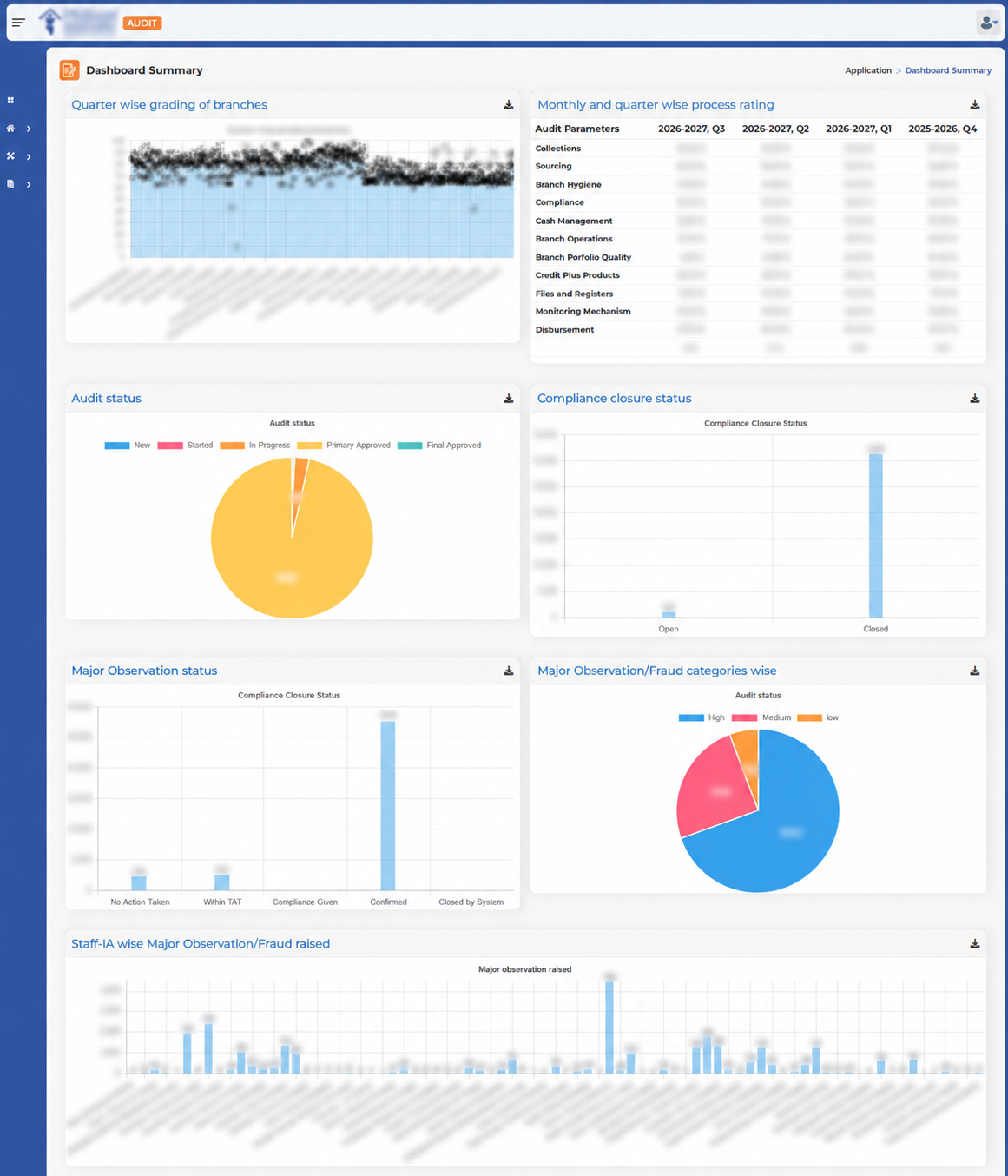
Web and mobile screens from a configured Internal Audit implementation. Sensitive details are blurred in five views, without censor boxes. Privacy-edited copies may contain small visual differences. Checklists, workflow stages and permissions are agreed for each implementation.
The difficult part of an audit is rarely producing another spreadsheet. It is keeping the questions, evidence, findings and responses connected as work passes between auditors, branch teams and approvers.
What better could look like
Keep evidence with the finding
Review responses and observations within the configured assessment.
Make the management response visible
Follow queries, replies and action ownership after fieldwork.
Review closure with context
Check the response and supporting evidence before accepting completion.
The people using the product
Audit lead
Configures the review and examines coverage.
Auditor
Records responses, samples and evidence.
Process owner
Responds to findings and completes agreed actions.
Authorised reviewer
Checks scores, reports and closure evidence.
Closure needs a chain of evidence.
Keep the observation, response and verification connected.
Field evidence
Capture questionnaire responses, sampling records and supporting observations.
TO EXPLORE
Configure the audit around the process
Arukus Internal Audit Management lets teams define processes and subprocesses, the sample information to collect, questions and response scores. Weightages reflect the contribution of each process to the overall assessment. Auto-sampling can be enabled where appropriate to the configured process.
Use the framework to evaluate field processes, back-office work and customer contact. In a lending operation, that may include group training, disbursement and recovery. For another enterprise, the questionnaire should be rebuilt around its actual operating procedures; financial-services questions should not simply be renamed.
Give auditors a practical field workflow
The mobile application shows assigned audits and the processes to be examined. Auditors can undertake physical cash verification, fixed-asset checks and process surveys, with online and offline working supported in the mobile workflow.
Cash checks compare physical denominations with records. Asset checks account for items such as equipment, furniture and computers. Process questionnaires bring repeatable structure to the assessment without removing the need for an auditor’s judgement.
- Define what must be captured for each sample.
- Record responses against the relevant process.
- Separate routine survey results from observations requiring investigation.
- Agree synchronisation, device access and evidence handling during implementation.
Capture the finding behind the grade
Non-sampling observations record issues that a questionnaire alone may not explain. Capture the customer or employee involved where relevant, the product or process, the root cause and action taken. Negative scores can be included in the overall branch assessment according to the configured scoring model.
Observations are assigned to responsible managers. Queries and replies remain part of the review, so an approver can examine what was raised, what was challenged and what response followed. Confirmed fraud observations can feed the fraud-management process where that integration is implemented.
Review progress beyond report publication
Dashboards show audit progress, observation levels, compliance closure and turnaround status. Teams can compare quarter-wise process ratings and branch grades, then drill into the work behind a deteriorating result.
The reporting set covers sampling and non-sampling work, organisational and support-process audits, scoresheets and operational follow-up. Views can be filtered by the relevant zone, region, branch and quarter. The benefit is a consistent review basis across locations, rather than a promise that software alone establishes compliance.
Build a walkthrough around one real audit
Share an audit programme, a sample questionnaire, scoring rules and a recent observation with its management response. We can demonstrate how those elements fit together, where configuration is sufficient and where a different process needs additional work. The result should be a usable audit workflow for the people conducting and responding to the audit.
What we can cover in a walkthrough
- Plan a review
- Record observations
- Agree a response
- Verify follow-up
Useful examples to bring: Questionnaire; completed audit; an overdue finding
Where the product can help
Consistent checks across locations
A central team needs comparable assessments from branches, outlets or operating units. Configured review formats help organise observations while allowing reviewers to explain the local circumstances.
A finding that needs a response
An observation is useful when the process owner understands the issue and the required next step. The review should retain the supporting record and make responsibility for follow-up explicit.
Questions for a considered decision
Can auditors work without connectivity?
The documented mobile workflow supports online and offline audit capture. Device, synchronisation and evidence-handling requirements should be tested for the intended deployment.
Can we configure our own questionnaires and scoring?
Yes. Processes, subprocesses, sample fields, question types, response scores and weightages are configurable. We map your audit methodology before rollout.
What happens after an observation is raised?
The workflow assigns responsibility and supports queries and responses. Dashboards and reports show observation status and closure or turnaround measures. The approval and follow-up process is agreed during implementation.
Can we pilot one audit type before a wider rollout?
Use one questionnaire, a representative branch set and your response and closure rules. Review the full cycle from evidence capture to management reply before expanding the methodology.
What should we test beyond questionnaire entry?
Include sampling, scoring, supporting evidence, returned responses and closure authority. For mobile fieldwork, test synchronisation and device conditions with the people who will conduct the audits.
What does implementation involve?
We agree configuration, data preparation, required interfaces, acceptance examples, training and rollout responsibilities. The delivery plan follows the scope.
How are deployment and integrations decided?
We review the chosen product, available interfaces, hosting requirements and operating owners. A named external system is not assumed to be connected out of the box.
Capabilities to explore in your walkthrough
- 01Configurable processes, subprocesses and questionnaires
- 02Sampling and non-sampling observations
- 03Physical cash verification and fixed-asset checks
- 04Weighted scores and branch grading
- 05Online and offline auditor mobile workflows
- 06Queries, responses, observation status and closure reporting
A practical next step, when the process is ready.
Proposed AI assistance could prepare a first draft of an observation from approved evidence, identify similar past findings or summarise unresolved responses. Auditors would verify source material and approve the final wording; AI would not determine the audit opinion.
Discuss an AI pilotResources for your evaluation

A Doctor Visit Is Logged. What Happens to the Follow-up?
A visit location is one piece of evidence. The purpose, outcome and next responsibility make that visit useful to the wider business.
Explore
Closing Plant Audit Findings Without Losing the Evidence
An inspection identifies the issue. Clear ownership and verified closure determine whether anything changes.
Explore
The Area Manager’s Outlet Review: From Store Observations to Assigned Actions
Store visits become more valuable when observations connect to named actions, evidence and regional follow-up.
Explore
Making Insurance Branch Risk Reviews Useful Between Reporting Cycles
Risk visibility improves when local observations, mitigation owners and evidence of follow-through remain connected.
ExploreSee Internal Audit Management in the context of your business.
Bring a sample process, a recent operating report and the people responsible for the work. We will focus the walkthrough on your requirements, available configuration and implementation scope.
Plan your product walkthrough