
Lending & growth
Arukus Cross-Sell
Turn customer relationships into your next growth opportunity.
Give customer-facing teams a structured way to record interest and move an opportunity forward. Arukus Cross-Sell helps keep the product conversation, customer context and next responsibility connected.
Plan your product walkthroughA relevant offer is the beginning.
Keep the next steps connected.
Explore how the field workspace, product catalogue and order views connect the customer conversation with the teams responsible for follow-through.
Keep the opportunity and the follow-up in view.
The mobile dashboard brings loan, cash, catalogue and insurance entry points together with order history, giving the field user a place to begin the next conversation and revisit recorded work.
- Four visible entry points for the configured offer types
- Order-history cards alongside the main workspace
- Loan/cash labels and order-status indicators in the supplied view
Privacy-edited screenshot. Customer names, phone numbers, document/order references, product names and amounts are masked. Visible statuses are examples from the captured interface.
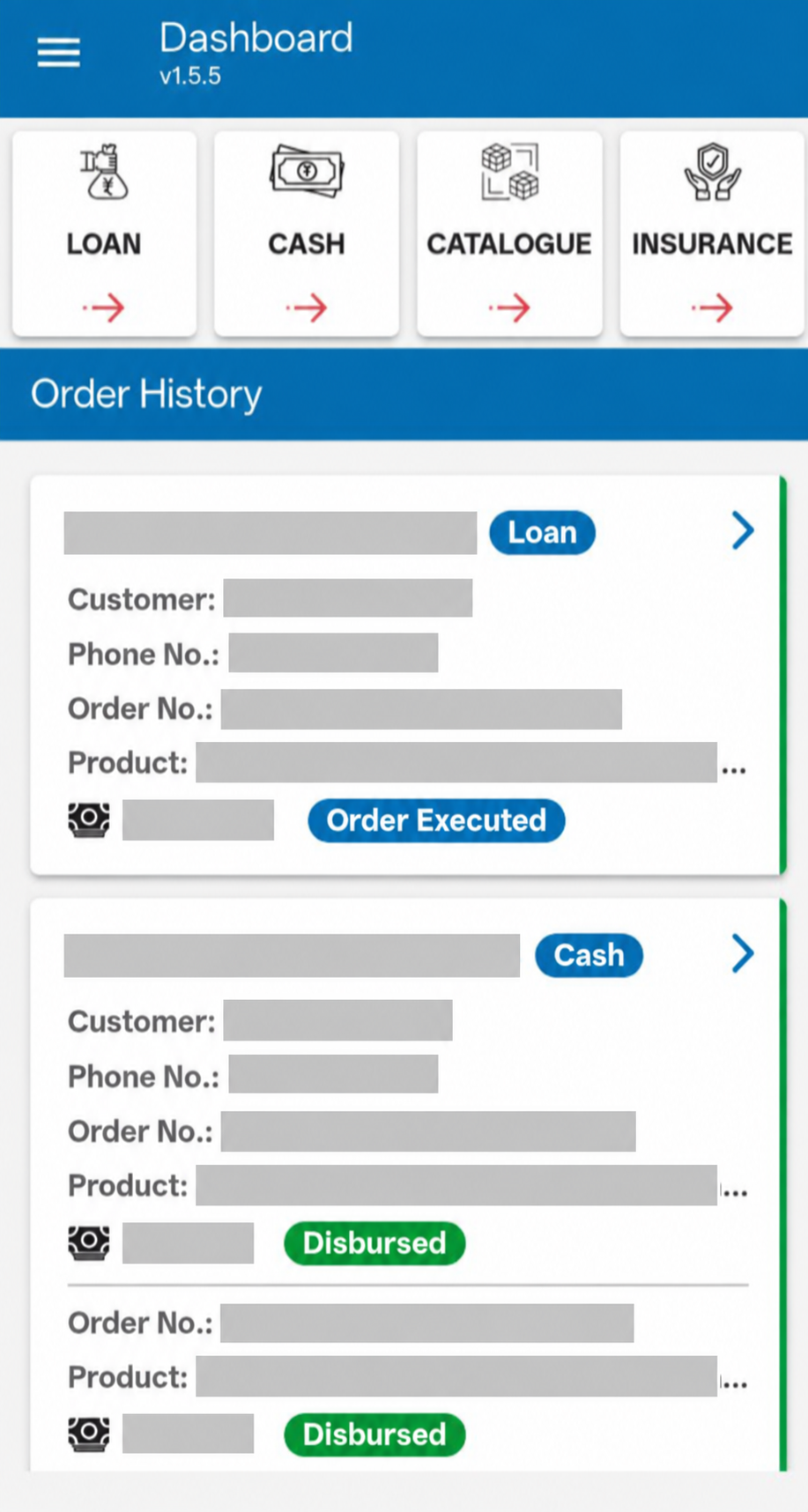
These screens illustrate a configured implementation. Four views have been edited to mask customer, staff and client-specific information; small visual differences may occur in edited copies. Product availability, fulfilment arrangements, permissions and applicable customer disclosures are agreed for each implementation.
An existing relationship can create an opportunity for another useful product. It can also create poor customer experiences if the offer is unsuitable, the interest is recorded without context or several people repeat the same follow-up.
What better could look like
Keep interest attached to the customer context
Record the opportunity and relevant product discussion.
Give the follow-up a responsible person
Make the next action clear to staff and management.
Retain the outcome
Review completed, declined and outstanding opportunities.
The people using the product
Customer-facing employee
Records expressed interest.
Opportunity owner
Completes the next follow-up.
Sales or operations supervisor
Reviews outstanding opportunities.
Administrator
Maintains the configured capture and operating stages.
Turn interest into a responsible next step.
Keep the customer context attached to every opportunity.
Record the interest
Capture the customer’s expressed interest and relevant context.
TO EXPLORE
Begin with a relevant customer need
Arukus Cross-Sell is intended to organise the path from an identified need to an agreed next action. The working discussion starts with what may be offered, who is permitted to introduce it and which customer information is appropriate to use.
For lending organisations, cross-selling should sit within the institution’s approved customer and product process. For another enterprise, the same principle applies: a product recommendation needs a business reason and a defined responsibility for follow-up.
Capture enough context for the next person
A useful opportunity record explains what prompted the conversation and what the customer expressed interest in. It should not leave the receiving team to guess why the opportunity was passed to them.
During discovery, we map the minimum information needed by the people taking the conversation forward. The form, stages and responsibilities must be checked against the chosen configuration. The product is not presented as a replacement for every function of a full CRM platform.
Make the handover practical
Agree who owns the first contact, how a customer’s response is recorded and what ends the follow-up. A process with too many stages can make simple work harder; one with too few can hide the responsibility for the next step.
The walkthrough should follow a realistic example from initial interest to outcome, including a customer who declines. That makes it easier to identify where the workflow needs a clear stop as well as a next action.
Assess the fit beyond financial services
Businesses with an existing customer base and a defined product catalogue may have similar coordination needs. Distribution, retail services and business service teams can assess whether the opportunity model fits their operating process.
A wider application requires its own terminology, permitted data use, product information and follow-up rules. These are fit-assessment opportunities rather than claims of ready-made deployments in every sector.
Bring one complete opportunity journey
Share the product catalogue, the current record used by staff and an example of a completed follow-up. We will examine the stages, responsibilities and reporting needs, then distinguish available configuration from additional development or integration work. The objective is a follow-up process staff can explain and managers can review.
What we can cover in a walkthrough
- Record customer interest
- Check the opportunity
- Assign the follow-up
- Review the outcome
Useful examples to bring: Product catalogue; completed follow-up; a declined opportunity
Where the product can help
Customer interest that needs an owner
A staff member identifies interest in another offering. The value of the record depends on a clear handover to the person who will follow it up.
An established customer base beyond lending
A business with a relevant catalogue and a follow-up team may have similar opportunity-management needs. Product fit depends on its offer model, permissions and required workflow.
Questions for a considered decision
Is this a complete replacement for our CRM?
It is assessed around the cross-sell journey and the relevant configuration. Broader CRM requirements need a separate fit and integration discussion.
Can it apply outside financial services?
Organisations with an existing customer base and a defined product catalogue may have a relevant use case. Product suitability, permissions and follow-up rules must be established.
Can AI send product recommendations automatically?
Automated recommendations are not assumed. Any proposed assistance needs appropriate data use, suitability checks and staff approval.
How do we decide which opportunities belong in the workflow?
Start with the products your organisation is authorised to offer and the customer information staff may use. Agree how interest, eligibility review and follow-up responsibility are recorded.
Can managers distinguish interest from a completed sale?
Define the stages and evidence required for each outcome during configuration. A customer expressing interest should remain distinct from acceptance, fulfilment and any confirmed business result.
What does implementation involve?
We agree configuration, data preparation, required interfaces, acceptance examples, training and rollout responsibilities. The delivery plan follows the scope.
How are deployment and integrations decided?
We review the chosen product, available interfaces, hosting requirements and operating owners. A named external system is not assumed to be connected out of the box.
Capabilities to explore in your walkthrough
- 01Customer interest capture
- 02Product and opportunity context
- 03Defined follow-up responsibilities
- 04Configurable forms and operating stages
- 05Outcome reporting scoped to the workflow
- 06Fit assessment for existing customer relationships
A practical next step, when the process is ready.
A proposed assistant could summarise a customer conversation or suggest a follow-up draft. Any product recommendation would need appropriate data use, suitability checks and staff approval before it reaches the customer.
Discuss an AI pilotSee Arukus Cross-Sell in the context of your business.
Bring a sample process, a recent operating report and the people responsible for the work. We will focus the walkthrough on your requirements, available configuration and implementation scope.
Plan your product walkthrough