
Lending & growth
Collection Management
Every collection, with the context behind it.
Give collection teams a working view of scheduled demand, payments, promises to pay and follow-up. Arukus connects the mobile collection record with branch and management oversight.
Plan your product walkthroughStart the visit with the relevant customer, loan and collection demand in view.
From the daily collection list
to a clearer management view.
Explore ten supplied application screens across field collections and central oversight. Switch between mobile collection tasks, web reporting, advance schedules and reversal review.
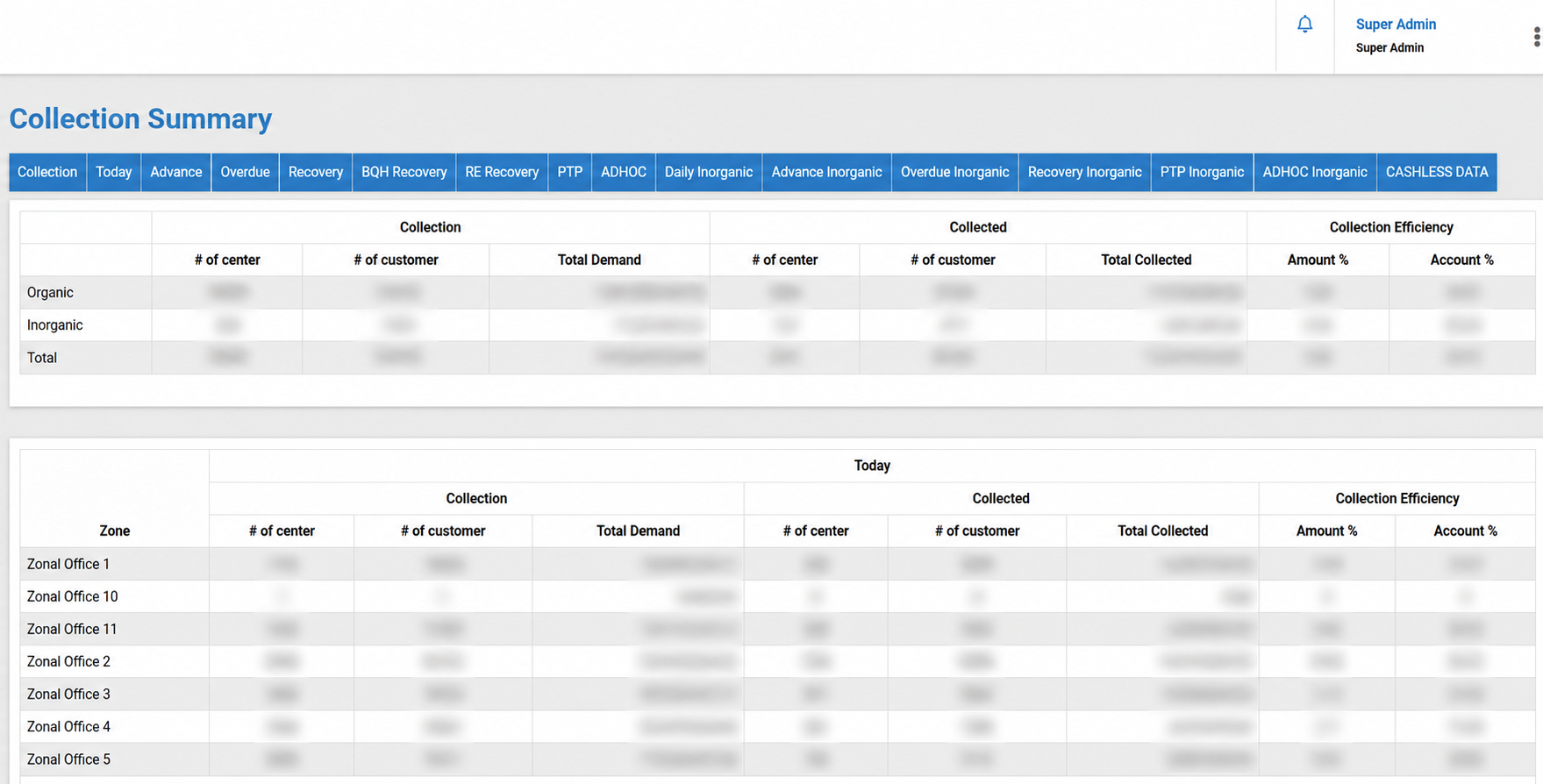
See demand, collections and efficiency together.
The web dashboard brings collection totals and zone-level performance into one management view.
- Daily, advance, overdue and recovery views
- Demand and collected amounts alongside account counts
- Collection efficiency by amount and account
Client logo removed. Numerical business values remain blurred.
Explore collection oversight, reporting, advance schedules and reversals on the web, alongside daily collection, overdue, privilege, payment and cash-denomination screens on mobile. Client logos have been removed where present, and identifying records remain blurred. Privacy-edited copies may contain small visual differences from the originals. Screens reflect a configured implementation.
A collection visit can end with a full payment, a partial payment, a promise or a reason for non-payment. Each outcome changes the next action. The application needs to capture that difference while keeping the customer, loan and collection record connected.
What better could look like
Keep the next follow-up explicit
Retain commitments, reasons and the responsible activity.
Review the working queue
Bring relevant demand and collection outcomes into the daily review.
Connect the field record with branch oversight
Examine payment context and unresolved follow-ups.
Collection employee
Records relevant customer visits and collection outcomes.
Branch supervisor
Reviews submissions, commitments and queues.
Collections head
Examines follow-up and branch reports.
Finance or reconciliation team
Reviews the records within its agreed handover scope.
Different queues. Connected follow-up.
Keep the collection context with the next action.
Scheduled demand
Review today’s, advance and other configured collection queues.
TO EXPLORE
Start with the right collection queue
The mobile workflow supports today’s collections, advance payments, overdue and recovery activity, promises to pay and ad hoc collections. Teams can work from centre, group and customer records rather than rebuilding the day’s demand manually.
The demand view accounts for overdue amounts, the current instalment and advance collections. Where a payment is less than the amount due, the agent records a promise-to-pay date and a reason. The next queue can then reflect the commitment requiring follow-up.
Record the visit as well as the amount
Customer attendance, group images and centre attendance register images provide supporting context. Cash denominations are captured when a centre meeting is submitted. The final view summarises collection and attendance, with location recorded at submission.
These records help a branch team examine an activity without depending entirely on a verbal update. They do not remove the need for cash controls, customer communication and supervisory checks outside the application.
Support the payment and connectivity model
The solution includes cash and supported digital-payment routes, with provider or device connections agreed during implementation. Successful payment can trigger a customer notification with a receipt link. The precise channels depend on the lender’s operating model and its authorised payment partners.
Offline collection capture is supported for the documented flows, with later synchronisation when connectivity returns; ad hoc collections are an exception in the supplied material. Implementation should establish reconciliation rules and how staff handle failed or delayed synchronisation.
Turn commitments into follow-up
Promise-to-pay planning and action reports help managers review commitments across the day and subsequent periods. Overdue and recovery reports provide a separate view of accounts needing attention. The platform also documents collection reversal, advance management and reassignment functions for authorised roles.
Management reporting spans total collections, overdue recovery, attendance, collection activity and organisational performance. Views can follow the zone, region, area, branch and loan-officer hierarchy used by the institution.
Connect collection visibility with field control
Collection records can be considered alongside activity and movement information where the relevant modules are integrated. A mismatch can be sent for review; it should not be presented as a confirmed fraud finding.
This product remains specifically relevant to lenders and their collection operations. Bring a demand file, a daily collection summary and a recent PTP follow-up example to the walkthrough. We can map the supported flows, payment interfaces and supervisory reports before agreeing the delivery scope.
What we can cover in a walkthrough
- Review the queue
- Assign follow-ups
- Record activity
- Review the next action
Useful examples to bring: Collection report; promise-to-pay example; branch submission process
Where the product can help
A collection queue with changing responsibilities
The field team and its supervisor need a shared understanding of assigned work and recorded outcomes. The workflow should make it clear who handles the next follow-up.
A review that needs more than a total
Managers need the context behind an activity record when examining what happened. Demonstrate the relevant records and reporting around a typical working day.
Questions for a considered decision
Which collection types are covered?
Documented flows include today’s, advance, overdue, recovery, promise-to-pay and ad hoc collections. Queue rules are mapped to the lender’s operating process.
What happens with a partial payment?
The agent records the payment, a reason for the shortfall and a promise-to-pay date where applicable. Managers can examine the subsequent commitment through planning and action reports.
Are digital payments and offline working available?
The documented solution includes supported digital-payment integrations and offline capture for specified flows, excluding ad hoc collections in the supplied material. Provider connections and synchronisation behaviour are confirmed during implementation.
How should we prepare a collection pilot?
Choose representative branches, demand records and follow-up situations. Agree how payment records, promises to pay and reconciliation will be checked against the source system during the pilot.
Does a recorded visit confirm that money was received?
Visit evidence and payment confirmation answer different questions. The agreed workflow must establish how receipts are verified and reconciled before a collection is treated as complete.
What does implementation involve?
We agree configuration, data preparation, required interfaces, acceptance examples, training and rollout responsibilities. The delivery plan follows the scope.
How are deployment and integrations decided?
We review the chosen product, available interfaces, hosting requirements and operating owners. A named external system is not assumed to be connected out of the box.
Capabilities to explore in your walkthrough
- 01Today’s, advance, overdue, recovery and ad hoc collections
- 02Promise-to-pay dates and follow-up queues
- 03Non-payment reasons and customer attendance
- 04Cash denominations and centre submission
- 05Offline capture and later synchronisation for supported flows
- 06Collection, PTP, recovery and branch-performance reports
A practical next step, when the process is ready.
A proposed assistant could prepare a manager’s daily collection brief or highlight commitments awaiting follow-up. Borrower communications, prioritisation policies and recovery actions would remain under the institution’s approved operating process.
Discuss an AI pilotResources for your evaluation

From Loan Application to Collection Follow-up: Where Lending Handovers Break Down
Lending visibility depends on the handovers between application capture, field review and continuing customer follow-up.
ExploreThe promise between visits.
An illustrative mfi & nbfc scenario about clearer evidence, ownership and follow-through.
Illustrative scenario • Not a customer deployment or a measured success claim.ExploreSee Collection Management in the context of your business.
Bring a sample process, a recent operating report and the people responsible for the work. We will focus the walkthrough on your requirements, available configuration and implementation scope.
Plan your product walkthrough